


How to Use CBT for ADHD: A Practical Guide That Actually Works

Discover CBT techniques for ADHD to reframe thoughts and boost focus.

Nov 2, 2025
14
 min read
Medically reviewed by
Table of contents:
A young man sits at a desk divided between chaos and organization, symbolizing the shift from ADHD overwhelm to structured thinking with visual thought bubbles.

Cognitive Behavioral Therapy (CBT) isn't about trying to "fix" a broken brain—because your brain isn't broken. Think of it as a science-backed, practical toolkit for managing ADHD. These techniques help you shift the thought patterns and behaviors that trip you up, so you can work with your unique wiring to boost your focus, organization, and emotional well-being.

Your ADHD Brain Isn’t Broken, It's Powerful

A person sitting calmly on a sofa, looking thoughtful and empowered in a brightly lit, modern living room.

If you have ADHD, you might recognize the sting of procrastination all too well. Maybe you've felt the chaos of disorganization or the sudden tidal wave of emotional overwhelm. It’s so easy to take those moments and turn them inward, branding them as personal failures—proof that you're somehow broken or just not trying hard enough.

But what if that whole story is just plain wrong?

🔬 Scientific Takeaway: The reality is simpler and way more empowering: your brain isn't broken; it's just wired differently. Think of it less like a deficit and more like a unique operating system with its own set of rules, strengths, and quirks. Shifting to this mindset is a huge part of building resilience with ADHD, which is an incredible asset.

Finding Your User Manual

This is exactly where Cognitive Behavioral Therapy (CBT) shines. It’s not here to change who you are at your core. Think of it as finally getting the user manual for your specific brain. CBT provides practical, science-backed CBT techniques for ADHD that are designed to help you work with your brain's natural tendencies, not against them.

This approach helps you:

  • ✅ Finally connect the dots between your thoughts, feelings, and actions.
  • ✅ Gently question and reframe that unhelpful inner monologue that just fuels frustration.
  • ✅ Build new, more effective strategies for getting through your day.

By focusing on skills instead of flaws, CBT flips the script from self-criticism to genuine self-understanding and empowerment. The goal isn't to become someone else—it's to become a more effective and confident version of yourself.

This guide will walk you through these powerful techniques one by one. We'll break down how you can start using them in your life right away.

💡 Tip: With tools like the Inflow app, which makes these strategies easy to practice daily, you can start building a better, more harmonious relationship with your ADHD brain today.

Have you ever felt like you were in a constant fight with your own mind? Let's explore a better way forward, together.

Ready to apply CBT to your daily life?

Inflow makes Cognitive Behavioral Therapy practical for ADHD brains — with short, science-based lessons that help you build awareness, change habits, and feel more in control day to day.

How CBT Helps Rewire Your Thought Patterns

To really get why Cognitive Behavioral Therapy is such a game-changer for ADHD, let's start with a simple but powerful idea. Imagine your ADHD brain is a high-performance race car—incredibly powerful and built for speed, but also super sensitive and quick to veer off track.

CBT doesn’t try to turn your race car into a sensible family sedan. Instead, it teaches you how to become an expert driver.

It gives you the skills to handle the sharp turns of procrastination, navigate the bumpy roads of emotional dysregulation, and stay focused on the track ahead. You learn to work with the car's unique power, not fight against it. For a closer look under the hood, you can learn more about the science of the ADHD brain.

This skill-building approach is exactly why CBT is such a trusted strategy. Research shows that CBT adapted for adults with ADHD has strong evidence backing it up. Early controlled trials found it led to reliable, moderate reductions in core ADHD symptoms compared to other supportive therapies.

Understanding the Thought-Feeling-Action Cycle

The engine of CBT is a concept called the thought-feeling-action cycle. It’s the idea that our thoughts, feelings, and behaviors are all tangled up together, each one influencing the others in a continuous loop. For those of us with ADHD, this cycle can often spin out of control on autopilot.

Here’s how it commonly plays out in an ADHD scenario:

  • Thought: You glance at a big, important project and your brain immediately pipes up: "I'll never get this done perfectly, so why even start?"
  • Feeling: That thought instantly triggers a wave of anxiety, overwhelm, or even shame.
  • Action (or Inaction): To escape those feelings, you might find yourself avoiding the task. You open social media, start a new show, or suddenly decide the kitchen needs a deep clean. Right now.

Does that sound familiar? You might recognize yourself in this pattern that fuels both procrastination and that harsh inner critic. It’s not a character flaw; it’s just a cognitive habit your brain has fallen into.

Pressing Pause on Autopilot

This is where CBT techniques for ADHD come in. CBT gives you the power to hit the pause button on this automatic, and often negative, cycle. It’s not about forcing yourself to "just think positive" or pretending your struggles don't exist. It’s about building self-awareness.

CBT teaches you to become a curious observer of your own mind. You learn to notice your thoughts without immediately accepting them as the gospel truth, question whether they’re actually accurate, and consciously choose a more helpful, balanced response.

For example, instead of letting the thought "I'll never get this done" run the show, you can learn to step in. You might challenge it by asking, "Is that 100% true? What's one tiny step I can do right now?"

This simple act of questioning breaks the chain reaction. It stops that automatic slide into anxiety and avoidance, giving you back a sense of control. This skill empowers you to navigate ADHD challenges with more intention and less stress.

Have you noticed this thought-feeling-action pattern in your own life?

Your Core CBT Toolkit for ADHD Management

Now that we know the "why" behind CBT, let's get into the "how." Think of this section as your starter toolkit—a few powerful, hands-on strategies you can start using today. This isn't about forcing yourself into a neurotypical box; it's about finding levers that actually work for your unique wiring.

We’ll focus on three of the most impactful CBT techniques for ADHD: Cognitive Restructuring, Behavioral Activation, and Environment Design. Each one tackles a different piece of the ADHD puzzle. The goal here is for you to walk away with at least one new tool you're genuinely excited to try.

Unhooking from Unhelpful Self-Talk

First up is Cognitive Restructuring, which is a way of saying "learning to challenge and reframe unhelpful self-talk." If you have ADHD, you know the inner critic can work overtime, serving up thoughts like, "I'm so lazy," or "I always mess things up."

Cognitive Restructuring teaches you to act like a gentle detective. Instead of just accepting these automatic thoughts as facts, you learn to question them.

For example, when your brain says, "This report is too big; I'll never finish it," you can pause and ask:

  • Is that 100% true? Have I finished big projects before?
  • What's a more balanced, helpful way to see this? Maybe: 'This is a big project, and I can start by just writing the first paragraph.'

This simple shift changes the emotional weather in your mind from overwhelming to manageable, making it much easier to take that first step.

Taking Action to Break Inertia

Next is Behavioral Activation, a powerful antidote to the procrastination and inertia that so often come with ADHD. The core idea is simple: action changes mood and motivation, not the other way around. Instead of waiting to feel ready, you use small, strategic actions to kickstart your brain's engine.

💡 Tip: You need to clean your messy kitchen, a task that feels enormous. Instead of focusing on the whole project, you commit to a tiny, "too small to fail" action, like "I will put just three dishes in the dishwasher." Often, that one small step breaks the paralysis and makes the next step feel possible.

This approach works because it bypasses the executive function traffic jam in your brain. It lowers the barrier to entry so much that your brain doesn't have a chance to protest.

Designing Your Space for Success

Finally, let's talk about Environment Design. This technique recognizes that willpower is a limited resource, especially for the ADHD brain. Instead of relying on sheer mental effort to stay focused, you proactively set up your physical and digital spaces to support your goals.

It's all about making your desired behaviors easier and your distracting habits harder.

🔬 Scientific Takeaway: Research consistently shows that CBT is effective for core ADHD symptoms and also helps with emotional challenges, like anxiety. Syntheses of recent studies highlight that organizational strategies, problem-solving, and mindfulness-based approaches are among the most effective components of CBT for managing ADHD. You can read the full research about these findings to understand the science better.

Putting this into practice might look like:

  • Minimizing Digital Distractions: Using an app blocker during work hours.
  • Creating a "Launch Pad": Setting out your keys, wallet, and work bag by the door the night before.
  • Organizing Your Workspace: Keeping your desk clear of everything except the one task you're working on.

While CBT primarily focuses on mental strategies, incorporating practical tools is also crucial. For example, learning to use effective time management strategies can complement your cognitive work. You can also find a deeper dive into creating ADHD-friendly to-do lists that actually work in our other guides. The Inflow app helps you put these ideas into practice with daily exercises, turning these powerful techniques into lasting habits.

Which of these three techniques feels most relevant to you right now?

Putting Cognitive Restructuring into Practice

Alright, let's move from theory to action with one of the most powerful CBT techniques for ADHD: Cognitive Restructuring.

You can think of this as a hands-on workshop for learning how to talk back to your inner critic. We’ll walk through it step-by-step using a classic ADHD scenario—that feeling of dread when you’re staring down a huge project.

The goal isn't to slap on some fake positivity. It’s about finding a more balanced, realistic, and—most importantly—actionable perspective. By practicing this consistently, you can turn a moment of paralysis into a moment of progress.

A Three-Step Process to Reframe Your Thoughts

When your brain serves up an automatic negative thought (often called an ANT), it can feel like an undeniable fact. The first step is learning to see it for what it is: just a thought. Here’s how you can gently start to question it.

Let's imagine the ANT is: "This project is impossible. I'm definitely going to fail."

  • ✅ Step 1: Identify the Automatic Thought. The first step is just to notice the thought without judging it. Catch it as it flies by. Sometimes, saying it out loud or scribbling it down can help create a little distance.
  • ✅ Step 2: Challenge it with Evidence. Now, it’s time to put on your detective hat. Gently question that thought. Is it 100% true? Ask yourself, "What's the real evidence here? Have I handled big projects before, even if they were tough?"
  • ✅ Step 3: Replace it with a Balanced Thought. The final step is to craft a new, more helpful thought. This shouldn't be blindly optimistic, just more realistic. For example, "This is impossible" can become "This is challenging, but I can handle challenging things. I'll start by just outlining the first section for 15 minutes."

This new thought doesn't pretend the difficulty isn't there. It acknowledges the challenge while pointing toward a small, manageable first step. That simple reframe can be the difference between staying stuck and actually getting started.

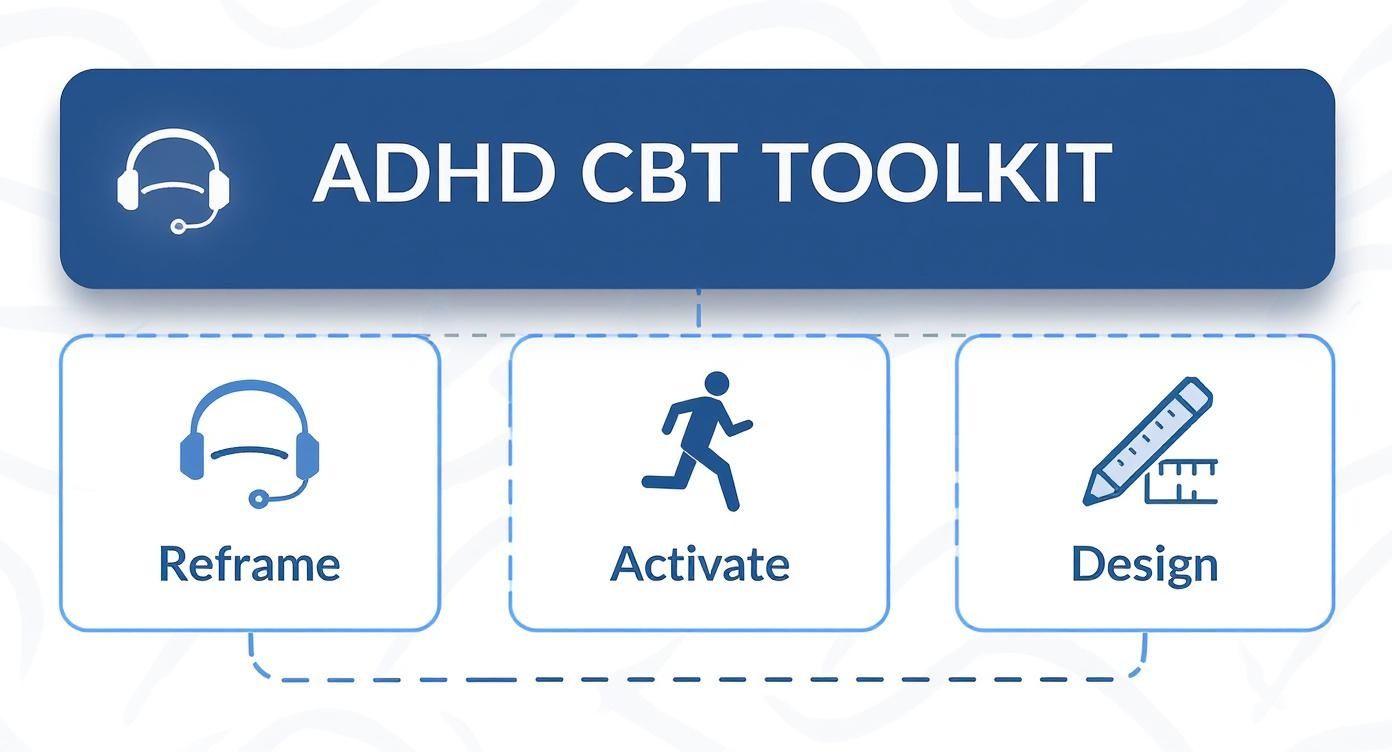
This flow chart breaks down how reframing your thoughts can activate new behaviors and help you design your environment for success.
Infographic about cbt techniques for adhd

As you can see, changing our internal narrative (Reframe) is the critical first move that makes it easier to take action (Activate) and set ourselves up for success (Design).

Turning This Technique into a Habit

Cognitive restructuring is like building a muscle; it gets stronger the more you use it. At first, it might feel a little clunky, but every time you catch, challenge, and change a thought, you're strengthening new neural pathways. You're literally rewiring your brain.

This is where having a structured program can make all the difference. The Inflow app acts like a personal coach for this exact process. With daily reminders and guided exercises, it helps you turn this powerful CBT technique into a consistent habit.

Ready to see what your unique ADHD patterns are? Take our ADHD quiz to get started and see how Inflow can help you.

Build lasting CBT habits with Inflow

Small, consistent actions lead to real change. The Inflow app helps you turn cognitive restructuring, mindfulness, and behavioral activation into daily ADHD-friendly habits.

Managing Emotional Dysregulation with Advanced CBT

A person sitting on a yoga mat in a calm, mindful pose, with soft natural light filtering into the room.

If you have ADHD, you know it’s not just about losing your keys or struggling to focus. There's a whole emotional side to it—those intense waves of feeling that can completely hijack your day. One minute you're fine, the next you're reeling from the sting of rejection or boiling over with frustration.

These emotional challenges are a huge, often overlooked part of the ADHD experience. This is where some of the more advanced CBT techniques for ADHD really shine.

It's not about stuffing your feelings down; it's about learning how to ride the emotional waves without getting swept out to sea.

Introducing Mindfulness-Based CBT

For a lot of us with ADHD, the word "mindfulness" can sound like an impossible instruction when your thoughts are bouncing off the walls.

But mindfulness isn’t about forcing your brain to be empty. It's the simple practice of noticing your thoughts and feelings without getting tangled up in them. No judgment allowed.

For the ADHD brain, this is a game-changing skill. It creates a tiny, crucial gap between feeling an emotion and reacting to it, giving you the space to choose your response.

Instead of being instantly steamrolled by frustration, you learn to step back and observe it: "Ah, there's that feeling of frustration again. Interesting." This simple act of noticing can drain the emotion of its overwhelming power. To build on this, various emotional regulation exercises can strengthen your ability to respond to intense feelings in a healthier way.

A Practical Mindfulness Exercise You Can Use Anywhere

Let's try a quick grounding exercise you can pull out of your back pocket anytime an emotion feels like it's taking over.

  • Step 1: Notice. Simply acknowledge the strong emotion without judging it. Tell yourself, "Okay, I'm feeling a big wave of anxiety right now."
  • Step 2: Anchor. Gently shift your attention to your breath. Feel the air moving in and out of your body. You don't have to change it, just observe it.
  • Step 3: Expand. Widen your awareness to the physical sensations around you. Notice the feeling of your feet flat on the floor or your hands resting in your lap.

Structured Problem-Solving for Emotional Situations

When you're emotionally fired up, even small problems can feel like massive, impossible mountains. CBT offers a structured, step-by-step approach to problem-solving that helps take the emotional heat out of the equation so you can actually think clearly.

🔬 Scientific Takeaway: These strategies are backed by solid research. Studies show that over 50% of adults with ADHD who complete CBT programs experience significant improvement in their symptoms. One key study found that 56% of participants were considered ‘treatment responders’ after the program, reporting not just fewer ADHD symptoms but also less anxiety and depression.

This process does more than just solve problems—it builds resilience and self-compassion. The Inflow app is designed to walk you through these very techniques, helping you turn these advanced CBT skills into reliable, everyday habits for navigating the emotional side of ADHD. Curious to see how it works? Take the Inflow quiz to start your journey.

Building Your Path Forward with CBT

We’ve covered a lot of ground—the science behind CBT and the specific strategies that work for ADHD. Now, let's talk about where you go from here. It's one thing to feel inspired by new tools; it's another to turn that motivation into a real, lasting habit.

Remember, CBT isn’t a quick fix. It’s a skill set you build over time, a new way of relating to your wonderfully unique brain. Think of it less like a cure and more like learning the language of your own mind. It takes practice, patience, and self-compassion.

Starting Small is The Smartest Way to Start

If you're feeling a mix of excitement and "where-do-I-even-begin?" overwhelm, that’s completely normal. The key is to resist that classic ADHD urge to change everything all at once. Meaningful change almost always starts with a single, manageable step.

So, here’s your invitation:

  • Choose just one technique from this guide that really clicked with you. Maybe it’s catching one negative thought a day, or using a small action to get moving on a task.
  • Commit to practicing only that one thing for the next week. Seriously. Don't worry about anything else for now. Just focus on building that one small habit.

This approach works with the ADHD brain, not against it. We thrive when big goals are broken down into tiny actions. Each small win builds momentum and confidence, making the next step feel that much easier.

Every small act of self-awareness is a step toward building a life that feels less like a struggle and more like an authentic expression of who you are.

Your Partner in Building Lasting Habits

You don’t have to figure all this out on your own. Integrating these strategies into the beautiful chaos of daily life is where having the right support can make all the difference. The Inflow app was designed specifically for this—to be your guide in turning these CBT techniques from ideas into lifelong skills.

With Inflow, you get:

  • Structured Learning: Bite-sized, daily lessons that make complex CBT concepts easy to digest and use.
  • Personalized Check-ins: Gentle reminders and exercises that help you practice skills like cognitive restructuring and mindfulness consistently.
  • A Community That Gets It: A space to connect with other adults with ADHD who understand the journey because they're on it, too.

If you’re ready to stop fighting your brain and start working with it, this is your next step. Take the Inflow quiz today to discover your unique ADHD patterns and begin building a personalized toolkit that truly works for you.

Common Questions About CBT for ADHD

Exploring new ways to manage your ADHD can bring up a lot of questions. It’s totally normal to feel a mix of hope and uncertainty. Let's tackle some of the most common queries about using CBT techniques for ADHD so you can move forward feeling confident.

Can I Use These Techniques on My Own?

Absolutely. You can definitely start practicing many of the core CBT skills by yourself. Things like catching negative thoughts, using behavioral activation to get a task started, or setting up a distraction-free workspace are perfect for self-guided practice.

That’s exactly why tools like the Inflow app were created—to give you the structure and daily exercises that make these skills feel more manageable. That said, working with a therapist who gets ADHD can offer personalized guidance. Many people find a tag-team approach of self-help tools and professional therapy is the most effective path.

How Long Does It Take to See Results?

This is a very personal journey, so there's no magic timeline. You might notice small but meaningful shifts in your day-to-day life within just a few weeks of consistent practice. For example, it might suddenly feel a tiny bit easier to stop a negative thought in its tracks.

More significant, lasting changes usually build up over several months of steady effort. The key here is consistency, not perfection. Think of it like building a new mental muscle—the real strength comes from showing up and doing the reps over time.

Is CBT a Replacement for ADHD Medication?

It's better to think of CBT as a powerful partner to medication, not a replacement. Medication can help manage the core neurobiological symptoms of ADHD, like inattention and impulsivity. This often creates the mental breathing room you need to actually engage with therapy.

CBT then swoops in to teach you the practical skills and coping strategies that medication alone can't provide. It’s the "how-to" guide for managing your time, emotions, and thoughts. Research shows that combining medication and CBT often leads to the best long-term outcomes for adults with ADHD.

If you're curious about how these techniques could fit into your life, a great first step is to better understand your own ADHD patterns. Take the Inflow quiz to get personalized insights and start building your unique toolkit today.


Take the next step with Inflow

CBT can help you transform frustration into focus — and Inflow makes it easy to start. Get your personalized ADHD plan and learn science-backed tools to manage attention, motivation, and emotions with confidence.

Can't find the content you're looking for?

Send a topic request to the Inflow's blog editors. If we publish your topic idea, it could end up helping other people like you!
Request a topic
Send feedback

How to Use CBT for ADHD: A Practical Guide That Actually Works

Discover CBT techniques for ADHD to reframe thoughts and boost focus.

A young man sits at a desk divided between chaos and organization, symbolizing the shift from ADHD overwhelm to structured thinking with visual thought bubbles.

Cognitive Behavioral Therapy (CBT) isn't about trying to "fix" a broken brain—because your brain isn't broken. Think of it as a science-backed, practical toolkit for managing ADHD. These techniques help you shift the thought patterns and behaviors that trip you up, so you can work with your unique wiring to boost your focus, organization, and emotional well-being.

Your ADHD Brain Isn’t Broken, It's Powerful

A person sitting calmly on a sofa, looking thoughtful and empowered in a brightly lit, modern living room.

If you have ADHD, you might recognize the sting of procrastination all too well. Maybe you've felt the chaos of disorganization or the sudden tidal wave of emotional overwhelm. It’s so easy to take those moments and turn them inward, branding them as personal failures—proof that you're somehow broken or just not trying hard enough.

But what if that whole story is just plain wrong?

🔬 Scientific Takeaway: The reality is simpler and way more empowering: your brain isn't broken; it's just wired differently. Think of it less like a deficit and more like a unique operating system with its own set of rules, strengths, and quirks. Shifting to this mindset is a huge part of building resilience with ADHD, which is an incredible asset.

Finding Your User Manual

This is exactly where Cognitive Behavioral Therapy (CBT) shines. It’s not here to change who you are at your core. Think of it as finally getting the user manual for your specific brain. CBT provides practical, science-backed CBT techniques for ADHD that are designed to help you work with your brain's natural tendencies, not against them.

This approach helps you:

  • ✅ Finally connect the dots between your thoughts, feelings, and actions.
  • ✅ Gently question and reframe that unhelpful inner monologue that just fuels frustration.
  • ✅ Build new, more effective strategies for getting through your day.

By focusing on skills instead of flaws, CBT flips the script from self-criticism to genuine self-understanding and empowerment. The goal isn't to become someone else—it's to become a more effective and confident version of yourself.

This guide will walk you through these powerful techniques one by one. We'll break down how you can start using them in your life right away.

💡 Tip: With tools like the Inflow app, which makes these strategies easy to practice daily, you can start building a better, more harmonious relationship with your ADHD brain today.

Have you ever felt like you were in a constant fight with your own mind? Let's explore a better way forward, together.

Ready to apply CBT to your daily life?

Inflow makes Cognitive Behavioral Therapy practical for ADHD brains — with short, science-based lessons that help you build awareness, change habits, and feel more in control day to day.

How CBT Helps Rewire Your Thought Patterns

To really get why Cognitive Behavioral Therapy is such a game-changer for ADHD, let's start with a simple but powerful idea. Imagine your ADHD brain is a high-performance race car—incredibly powerful and built for speed, but also super sensitive and quick to veer off track.

CBT doesn’t try to turn your race car into a sensible family sedan. Instead, it teaches you how to become an expert driver.

It gives you the skills to handle the sharp turns of procrastination, navigate the bumpy roads of emotional dysregulation, and stay focused on the track ahead. You learn to work with the car's unique power, not fight against it. For a closer look under the hood, you can learn more about the science of the ADHD brain.

This skill-building approach is exactly why CBT is such a trusted strategy. Research shows that CBT adapted for adults with ADHD has strong evidence backing it up. Early controlled trials found it led to reliable, moderate reductions in core ADHD symptoms compared to other supportive therapies.

Understanding the Thought-Feeling-Action Cycle

The engine of CBT is a concept called the thought-feeling-action cycle. It’s the idea that our thoughts, feelings, and behaviors are all tangled up together, each one influencing the others in a continuous loop. For those of us with ADHD, this cycle can often spin out of control on autopilot.

Here’s how it commonly plays out in an ADHD scenario:

  • Thought: You glance at a big, important project and your brain immediately pipes up: "I'll never get this done perfectly, so why even start?"
  • Feeling: That thought instantly triggers a wave of anxiety, overwhelm, or even shame.
  • Action (or Inaction): To escape those feelings, you might find yourself avoiding the task. You open social media, start a new show, or suddenly decide the kitchen needs a deep clean. Right now.

Does that sound familiar? You might recognize yourself in this pattern that fuels both procrastination and that harsh inner critic. It’s not a character flaw; it’s just a cognitive habit your brain has fallen into.

Pressing Pause on Autopilot

This is where CBT techniques for ADHD come in. CBT gives you the power to hit the pause button on this automatic, and often negative, cycle. It’s not about forcing yourself to "just think positive" or pretending your struggles don't exist. It’s about building self-awareness.

CBT teaches you to become a curious observer of your own mind. You learn to notice your thoughts without immediately accepting them as the gospel truth, question whether they’re actually accurate, and consciously choose a more helpful, balanced response.

For example, instead of letting the thought "I'll never get this done" run the show, you can learn to step in. You might challenge it by asking, "Is that 100% true? What's one tiny step I can do right now?"

This simple act of questioning breaks the chain reaction. It stops that automatic slide into anxiety and avoidance, giving you back a sense of control. This skill empowers you to navigate ADHD challenges with more intention and less stress.

Have you noticed this thought-feeling-action pattern in your own life?

Your Core CBT Toolkit for ADHD Management

Now that we know the "why" behind CBT, let's get into the "how." Think of this section as your starter toolkit—a few powerful, hands-on strategies you can start using today. This isn't about forcing yourself into a neurotypical box; it's about finding levers that actually work for your unique wiring.

We’ll focus on three of the most impactful CBT techniques for ADHD: Cognitive Restructuring, Behavioral Activation, and Environment Design. Each one tackles a different piece of the ADHD puzzle. The goal here is for you to walk away with at least one new tool you're genuinely excited to try.

Unhooking from Unhelpful Self-Talk

First up is Cognitive Restructuring, which is a way of saying "learning to challenge and reframe unhelpful self-talk." If you have ADHD, you know the inner critic can work overtime, serving up thoughts like, "I'm so lazy," or "I always mess things up."

Cognitive Restructuring teaches you to act like a gentle detective. Instead of just accepting these automatic thoughts as facts, you learn to question them.

For example, when your brain says, "This report is too big; I'll never finish it," you can pause and ask:

  • Is that 100% true? Have I finished big projects before?
  • What's a more balanced, helpful way to see this? Maybe: 'This is a big project, and I can start by just writing the first paragraph.'

This simple shift changes the emotional weather in your mind from overwhelming to manageable, making it much easier to take that first step.

Taking Action to Break Inertia

Next is Behavioral Activation, a powerful antidote to the procrastination and inertia that so often come with ADHD. The core idea is simple: action changes mood and motivation, not the other way around. Instead of waiting to feel ready, you use small, strategic actions to kickstart your brain's engine.

💡 Tip: You need to clean your messy kitchen, a task that feels enormous. Instead of focusing on the whole project, you commit to a tiny, "too small to fail" action, like "I will put just three dishes in the dishwasher." Often, that one small step breaks the paralysis and makes the next step feel possible.

This approach works because it bypasses the executive function traffic jam in your brain. It lowers the barrier to entry so much that your brain doesn't have a chance to protest.

Designing Your Space for Success

Finally, let's talk about Environment Design. This technique recognizes that willpower is a limited resource, especially for the ADHD brain. Instead of relying on sheer mental effort to stay focused, you proactively set up your physical and digital spaces to support your goals.

It's all about making your desired behaviors easier and your distracting habits harder.

🔬 Scientific Takeaway: Research consistently shows that CBT is effective for core ADHD symptoms and also helps with emotional challenges, like anxiety. Syntheses of recent studies highlight that organizational strategies, problem-solving, and mindfulness-based approaches are among the most effective components of CBT for managing ADHD. You can read the full research about these findings to understand the science better.

Putting this into practice might look like:

  • Minimizing Digital Distractions: Using an app blocker during work hours.
  • Creating a "Launch Pad": Setting out your keys, wallet, and work bag by the door the night before.
  • Organizing Your Workspace: Keeping your desk clear of everything except the one task you're working on.

While CBT primarily focuses on mental strategies, incorporating practical tools is also crucial. For example, learning to use effective time management strategies can complement your cognitive work. You can also find a deeper dive into creating ADHD-friendly to-do lists that actually work in our other guides. The Inflow app helps you put these ideas into practice with daily exercises, turning these powerful techniques into lasting habits.

Which of these three techniques feels most relevant to you right now?

Putting Cognitive Restructuring into Practice

Alright, let's move from theory to action with one of the most powerful CBT techniques for ADHD: Cognitive Restructuring.

You can think of this as a hands-on workshop for learning how to talk back to your inner critic. We’ll walk through it step-by-step using a classic ADHD scenario—that feeling of dread when you’re staring down a huge project.

The goal isn't to slap on some fake positivity. It’s about finding a more balanced, realistic, and—most importantly—actionable perspective. By practicing this consistently, you can turn a moment of paralysis into a moment of progress.

A Three-Step Process to Reframe Your Thoughts

When your brain serves up an automatic negative thought (often called an ANT), it can feel like an undeniable fact. The first step is learning to see it for what it is: just a thought. Here’s how you can gently start to question it.

Let's imagine the ANT is: "This project is impossible. I'm definitely going to fail."

  • ✅ Step 1: Identify the Automatic Thought. The first step is just to notice the thought without judging it. Catch it as it flies by. Sometimes, saying it out loud or scribbling it down can help create a little distance.
  • ✅ Step 2: Challenge it with Evidence. Now, it’s time to put on your detective hat. Gently question that thought. Is it 100% true? Ask yourself, "What's the real evidence here? Have I handled big projects before, even if they were tough?"
  • ✅ Step 3: Replace it with a Balanced Thought. The final step is to craft a new, more helpful thought. This shouldn't be blindly optimistic, just more realistic. For example, "This is impossible" can become "This is challenging, but I can handle challenging things. I'll start by just outlining the first section for 15 minutes."

This new thought doesn't pretend the difficulty isn't there. It acknowledges the challenge while pointing toward a small, manageable first step. That simple reframe can be the difference between staying stuck and actually getting started.

This flow chart breaks down how reframing your thoughts can activate new behaviors and help you design your environment for success.

Infographic about cbt techniques for adhd

As you can see, changing our internal narrative (Reframe) is the critical first move that makes it easier to take action (Activate) and set ourselves up for success (Design).

Turning This Technique into a Habit

Cognitive restructuring is like building a muscle; it gets stronger the more you use it. At first, it might feel a little clunky, but every time you catch, challenge, and change a thought, you're strengthening new neural pathways. You're literally rewiring your brain.

This is where having a structured program can make all the difference. The Inflow app acts like a personal coach for this exact process. With daily reminders and guided exercises, it helps you turn this powerful CBT technique into a consistent habit.

Ready to see what your unique ADHD patterns are? Take our ADHD quiz to get started and see how Inflow can help you.

Build lasting CBT habits with Inflow

Small, consistent actions lead to real change. The Inflow app helps you turn cognitive restructuring, mindfulness, and behavioral activation into daily ADHD-friendly habits.

Managing Emotional Dysregulation with Advanced CBT

A person sitting on a yoga mat in a calm, mindful pose, with soft natural light filtering into the room.

If you have ADHD, you know it’s not just about losing your keys or struggling to focus. There's a whole emotional side to it—those intense waves of feeling that can completely hijack your day. One minute you're fine, the next you're reeling from the sting of rejection or boiling over with frustration.

These emotional challenges are a huge, often overlooked part of the ADHD experience. This is where some of the more advanced CBT techniques for ADHD really shine.

It's not about stuffing your feelings down; it's about learning how to ride the emotional waves without getting swept out to sea.

Introducing Mindfulness-Based CBT

For a lot of us with ADHD, the word "mindfulness" can sound like an impossible instruction when your thoughts are bouncing off the walls.

But mindfulness isn’t about forcing your brain to be empty. It's the simple practice of noticing your thoughts and feelings without getting tangled up in them. No judgment allowed.

For the ADHD brain, this is a game-changing skill. It creates a tiny, crucial gap between feeling an emotion and reacting to it, giving you the space to choose your response.

Instead of being instantly steamrolled by frustration, you learn to step back and observe it: "Ah, there's that feeling of frustration again. Interesting." This simple act of noticing can drain the emotion of its overwhelming power. To build on this, various emotional regulation exercises can strengthen your ability to respond to intense feelings in a healthier way.

A Practical Mindfulness Exercise You Can Use Anywhere

Let's try a quick grounding exercise you can pull out of your back pocket anytime an emotion feels like it's taking over.

  • Step 1: Notice. Simply acknowledge the strong emotion without judging it. Tell yourself, "Okay, I'm feeling a big wave of anxiety right now."
  • Step 2: Anchor. Gently shift your attention to your breath. Feel the air moving in and out of your body. You don't have to change it, just observe it.
  • Step 3: Expand. Widen your awareness to the physical sensations around you. Notice the feeling of your feet flat on the floor or your hands resting in your lap.

Structured Problem-Solving for Emotional Situations

When you're emotionally fired up, even small problems can feel like massive, impossible mountains. CBT offers a structured, step-by-step approach to problem-solving that helps take the emotional heat out of the equation so you can actually think clearly.

🔬 Scientific Takeaway: These strategies are backed by solid research. Studies show that over 50% of adults with ADHD who complete CBT programs experience significant improvement in their symptoms. One key study found that 56% of participants were considered ‘treatment responders’ after the program, reporting not just fewer ADHD symptoms but also less anxiety and depression.

This process does more than just solve problems—it builds resilience and self-compassion. The Inflow app is designed to walk you through these very techniques, helping you turn these advanced CBT skills into reliable, everyday habits for navigating the emotional side of ADHD. Curious to see how it works? Take the Inflow quiz to start your journey.

Building Your Path Forward with CBT

We’ve covered a lot of ground—the science behind CBT and the specific strategies that work for ADHD. Now, let's talk about where you go from here. It's one thing to feel inspired by new tools; it's another to turn that motivation into a real, lasting habit.

Remember, CBT isn’t a quick fix. It’s a skill set you build over time, a new way of relating to your wonderfully unique brain. Think of it less like a cure and more like learning the language of your own mind. It takes practice, patience, and self-compassion.

Starting Small is The Smartest Way to Start

If you're feeling a mix of excitement and "where-do-I-even-begin?" overwhelm, that’s completely normal. The key is to resist that classic ADHD urge to change everything all at once. Meaningful change almost always starts with a single, manageable step.

So, here’s your invitation:

  • Choose just one technique from this guide that really clicked with you. Maybe it’s catching one negative thought a day, or using a small action to get moving on a task.
  • Commit to practicing only that one thing for the next week. Seriously. Don't worry about anything else for now. Just focus on building that one small habit.

This approach works with the ADHD brain, not against it. We thrive when big goals are broken down into tiny actions. Each small win builds momentum and confidence, making the next step feel that much easier.

Every small act of self-awareness is a step toward building a life that feels less like a struggle and more like an authentic expression of who you are.

Your Partner in Building Lasting Habits

You don’t have to figure all this out on your own. Integrating these strategies into the beautiful chaos of daily life is where having the right support can make all the difference. The Inflow app was designed specifically for this—to be your guide in turning these CBT techniques from ideas into lifelong skills.

With Inflow, you get:

  • Structured Learning: Bite-sized, daily lessons that make complex CBT concepts easy to digest and use.
  • Personalized Check-ins: Gentle reminders and exercises that help you practice skills like cognitive restructuring and mindfulness consistently.
  • A Community That Gets It: A space to connect with other adults with ADHD who understand the journey because they're on it, too.

If you’re ready to stop fighting your brain and start working with it, this is your next step. Take the Inflow quiz today to discover your unique ADHD patterns and begin building a personalized toolkit that truly works for you.

Common Questions About CBT for ADHD

Exploring new ways to manage your ADHD can bring up a lot of questions. It’s totally normal to feel a mix of hope and uncertainty. Let's tackle some of the most common queries about using CBT techniques for ADHD so you can move forward feeling confident.

Can I Use These Techniques on My Own?

Absolutely. You can definitely start practicing many of the core CBT skills by yourself. Things like catching negative thoughts, using behavioral activation to get a task started, or setting up a distraction-free workspace are perfect for self-guided practice.

That’s exactly why tools like the Inflow app were created—to give you the structure and daily exercises that make these skills feel more manageable. That said, working with a therapist who gets ADHD can offer personalized guidance. Many people find a tag-team approach of self-help tools and professional therapy is the most effective path.

How Long Does It Take to See Results?

This is a very personal journey, so there's no magic timeline. You might notice small but meaningful shifts in your day-to-day life within just a few weeks of consistent practice. For example, it might suddenly feel a tiny bit easier to stop a negative thought in its tracks.

More significant, lasting changes usually build up over several months of steady effort. The key here is consistency, not perfection. Think of it like building a new mental muscle—the real strength comes from showing up and doing the reps over time.

Is CBT a Replacement for ADHD Medication?

It's better to think of CBT as a powerful partner to medication, not a replacement. Medication can help manage the core neurobiological symptoms of ADHD, like inattention and impulsivity. This often creates the mental breathing room you need to actually engage with therapy.

CBT then swoops in to teach you the practical skills and coping strategies that medication alone can't provide. It’s the "how-to" guide for managing your time, emotions, and thoughts. Research shows that combining medication and CBT often leads to the best long-term outcomes for adults with ADHD.

If you're curious about how these techniques could fit into your life, a great first step is to better understand your own ADHD patterns. Take the Inflow quiz to get personalized insights and start building your unique toolkit today.

Take the next step with Inflow

CBT can help you transform frustration into focus — and Inflow makes it easy to start. Get your personalized ADHD plan and learn science-backed tools to manage attention, motivation, and emotions with confidence.

Looking for support?

Inflow can help you thrive with ADHD and reach your full potential. Start your journey now by taking our quiz.

Take the quiz