

You've tried to build a morning routine probably more times than you can count. You've made lists, set alarms, downloaded apps. Sometimes it works for a few days. Then life happens — one late night, one difficult morning, one broken streak — and the whole thing collapses like it was never there.
Fabulous is genuinely built on solid science. The habit stacking approach, the gradual progression, the coaching tone — it's more thoughtfully designed than most. And for many people, it works.
But ADHD has a complicated relationship with streak-based habit apps. The very mechanism that motivates neurotypical users — the streak counter, the visual chain, the fear of breaking it — can become a source of shame for ADHD brains that engage inconsistently by default. And once shame arrives, avoidance follows.
This guide looks at what Fabulous offers, where it runs into ADHD-specific friction, and six alternatives worth exploring.
What Is Fabulous?

Fabulous is a habit and routine-building app grounded in behavioural science, developed in partnership with Duke University's Center for Advanced Hindsight. It builds rituals incrementally — starting with one small action and layering from there.
At a glance:
- Best known for: Science-backed habit stacking with a coaching tone
- Main use case: Building morning and evening routines through incremental daily habits
- Designed for: General adults — not built for ADHD specifically
- Pricing: ~$39.99/year. 7-day free trial. Note: billing complaints have been reported in 2026 user reviews — review subscription terms carefully before subscribing.
- Platforms: iOS, Android
Is Fabulous Good for ADHD?
Better than most general habit apps — and also limited by the same pattern.
Where it actually helps
Incremental habit stacking reduces the overwhelm of starting from zero. Fabulous doesn't ask you to build a complete morning routine on day one. It starts with one small action — drink a glass of water — and adds from there. This graduated approach is more realistic for ADHD brains than a fully-designed routine that requires consistent daily execution immediately.
The coaching notifications feel human. The push notifications use a warm, direct tone that feels closer to encouragement than a system reminder. That difference in framing matters for ADHD adults who are already self-critical.
The Journey format provides structure. Instead of designing your own routine from scratch — which is its own executive function task — Fabulous offers pre-built Journeys that guide you through a progression. Less setup overhead for ADHD brains.
Where it falls short for ADHD
Streak mechanics create shame when ADHD inconsistency shows up. Miss a day, and the streak resets. For an ADHD adult who was genuinely trying and hit an unavoidable obstacle — a hard week, a depressive dip, an hyperfocus spiral — the reset can feel like evidence of failure. And evidence of failure leads to avoidance.
Fabulous builds the routine but doesn't explain why ADHD makes routines hard. The app assumes motivation is the input and routine is the output. For ADHD, it's more complicated — time blindness, executive dysfunction, and shame about past failures all interfere before motivation ever has a chance.
Six Alternatives Worth Trying
1. Inflow — Understanding Why the Routine Keeps Collapsing
.png)
Fabulous tells you what to do each morning. Inflow helps you understand why the first step feels impossible even when you know exactly what it is.
The app is built specifically for ADHD — CBT-based content covering the patterns that make routines so unreliable for ADHD brains: time blindness, shame cycles, initiation difficulty, and the specific exhaustion of trying and failing the same system repeatedly.
Crucially, Inflow has no streak mechanics. It was designed specifically for the inconsistent, nonlinear engagement that ADHD produces — so returning after a gap doesn't come with a punishment.
What's inside:
- CBT modules on why ADHD disrupts routines — not just tips, but genuine understanding of the patterns involved
- Virtual coworking rooms — body doubling that helps you start the first step when internal motivation isn't available
- Quinn, the AI support tool — available in real time when you're standing in the hallway unable to begin
- Community of ADHD adults who understand the routine-collapse cycle intimately
7-day free trial. Refund available within 7 days of first payment if subscribed through Inflow's website and not meaningfully used.
Pricing: From $0.33/day (billed annually).
Platforms: iOS, Android.
Try it: Take Inflow's ADHD quiz to get started.
2. Routinery — Timer-Based Step-by-Step Routine Execution
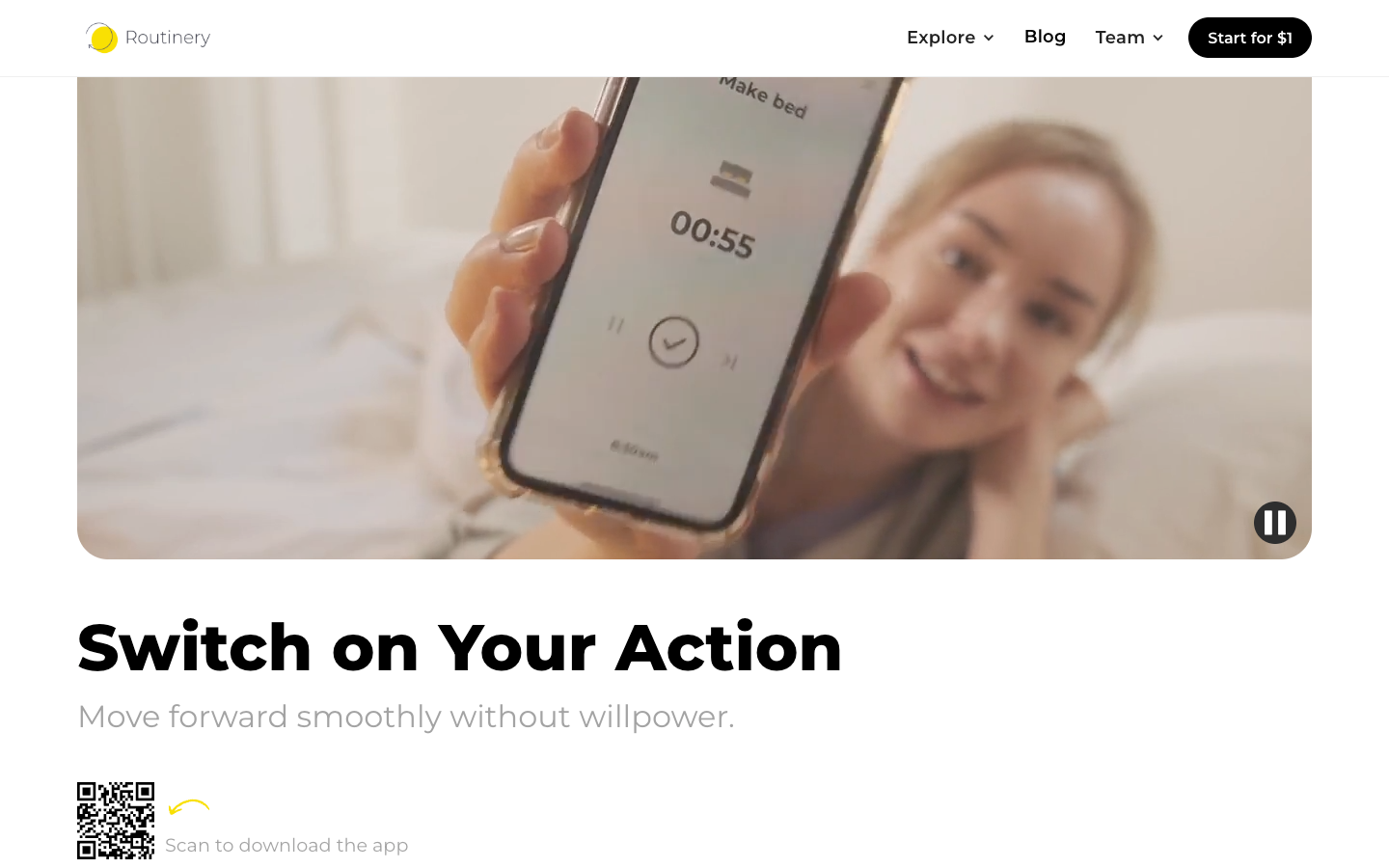
Routinery takes a different approach to routine-building than Fabulous. Instead of motivating you to start a habit, it walks you through each step with a countdown timer — making time visible and automatic transitions removing the "what next?" gap that ADHD stalls on.
Where Fabulous builds habits through coaching and streaks, Routinery executes them through real-time guidance. Both have value. They address different parts of the same problem.
Best for: ADHD adults who know what their routine should be and need external structure to execute it step-by-step — particularly for morning or evening sequences.
Considerations: Setup requires planning effort. Doesn't address task initiation before pressing start. Post-update bug reports flagged in 2026 reviews.
Pricing: Free tier (limited). Premium ~$27.49/year.
Platforms: iOS, Android, Web, Apple Watch.
3. Tiimo — Visual Planning That Makes Time Visible All Day
Tiimo is a visual daily planner designed specifically for neurodivergent users. It places activities on a colour-coded timeline, runs timers per activity, and sends gentle transition reminders throughout the day.
Where Fabulous focuses on morning habits in isolation, Tiimo addresses the whole day — including whether the morning routine you've designed actually fits within the time available before your first commitment.
Best for: ADHD adults whose routine problems extend beyond the morning — who struggle with time blindness across the full day, not just the first 30 minutes.
Pricing: Free tier. Pro ~$7–$12/month depending on region.
Platforms: iOS, Android, Web, Apple Watch.
4. Finch — When the Streak Has Broken and Shame Has Arrived
Finch is a self-care app built around a virtual pet bird. No streaks. No performance standard. No record of the days you didn't show up. Just small, self-defined wellness goals with a gentle, non-judgmental structure.
If Fabulous's broken streak has become a source of guilt — if even opening the app now feels like a reminder of failure — Finch is the reset button before you try any structured routine tool again.
Best for: ADHD adults who need to rebuild a relationship with daily self-care after burning out on streak-based apps.
Considerations: Very gentle by design. Doesn't build skills or address ADHD patterns. A bridge, not a long-term solution on its own.
Pricing: Free core version. Finch Plus ~$69.99/year.
Platforms: iOS, Android.
5. Focusmate — External Accountability for the First Step

Focusmate pairs you with another person over video for a defined work session. Applied to routines, booking a morning Focusmate session creates a social obligation that makes starting externally motivated rather than internally generated.
For ADHD adults whose routine problem is initiation — they know the steps, the steps are ready, and they still can't begin — another person's presence addresses the mechanism directly.
Best for: ADHD adults who have the routine in place but need external accountability to start it consistently.
Pricing: Free (3 sessions/week). $8/month billed annually for unlimited.
Platforms: Web only.
6. Wysa — CBT Support When the Routine Fails and Shame Follows
Wysa is a free AI-powered mental health chatbot grounded in CBT and DBT. Short, conversational emotional check-ins — available any time without scheduling.
When the routine collapses and the internal commentary starts — "I always do this," "I'll never change," "what's wrong with me" — Wysa addresses those thought patterns before they turn into a week of avoidance.
Best for: ADHD adults who need emotional support in the aftermath of a routine failure, before the self-criticism spiral takes hold.
Pricing: Free core tier.
Platforms: iOS, Android, Web.
Side-by-Side Comparison
How to Choose
You want a guided, incremental approach to building morning habits. Fabulous. The behavioural science is genuine and the coaching tone is well-suited to ADHD motivation — as long as the streak pressure doesn't become a source of shame.
You want to understand why routines keep failing for your ADHD brain. Inflow. CBT-based content, no streak mechanics, and support for the initiation gap. Take the quiz.
You need step-by-step execution with timers, not motivation coaching. Routinery. Timer-guided transitions for mornings and evenings.
Time blindness is the problem across the whole day. Tiimo for visual timeline planning.
You've burned out and need a reset before trying again. Finch. No performance standard, always frictionless to return to.
The routine is ready but you can't start it alone. Focusmate. External social accountability for the first step.
Final Thoughts
Fabulous is a well-made app built on legitimate science. The habit stacking approach is more ADHD-compatible than most routine tools, and for many users, it genuinely works.
Where it runs into limits is the streak model — which assumes that consistency is the input and routine is the output. For ADHD brains, inconsistency is a symptom of the condition, not a lack of effort. Apps that penalise inconsistency with shame mechanics can make the underlying pattern worse.
The alternatives above address different parts of the same challenge — from execution support to understanding the patterns to resetting when everything has collapsed.
Find what works for your brain
Take Inflow's free ADHD quiz to understand what's getting in the way of your routines — and what kind of support might actually help. 7-day free trial, refund available within 7 days of first payment through Inflow's website.
Frequently Asked Questions
Is Fabulous good for ADHD?
Fabulous uses legitimate behavioural science and its incremental habit stacking approach is more ADHD-compatible than all-or-nothing routine tools. Its main limitations for ADHD are streak mechanics that create shame when engagement is inconsistent, and no ADHD-specific content to address the patterns that make routines hard to maintain.
What is the best routine app for ADHD?
Routinery for step-by-step timer-guided execution. Tiimo for visual timeline planning across the full day. For ADHD adults who need to understand why routines keep failing, Inflow provides the CBT-based psychoeducation that routine apps cannot.
Does Fabulous work for ADHD?
For some ADHD adults, yes — particularly for the incremental habit building approach and the low-pressure early stages. For ADHD adults who engage inconsistently or find streak mechanics discouraging, it tends to follow the same build-and-abandon cycle as other habit apps.
What habit apps have no streak mechanics for ADHD?
Inflow, Finch, and Tiimo are all designed without punishing streak mechanics. Inflow specifically addresses why ADHD engagement is inconsistent — making the no-streak design a deliberate feature rather than just a missing option.


