

There's a very specific kind of ADHD experience that goes like this: you spend an hour setting up your task manager perfectly — labels, priorities, due dates, subtasks, everything in the right place. And then you close the app and don't do any of the tasks.
The problem was never the list. The list was fine. It's the gap between the list and actually doing anything on it.
Todoist is one of the best task managers available. It's clean, cross-platform, reliable, and powerful enough to manage complex projects. For many ADHD adults, it's also a place where well-intentioned tasks go to sit quietly while you do something else.
This guide looks at what Todoist does well, where it runs into the specific walls that ADHD builds, and six alternatives that address different parts of the problem.
What Is Todoist?
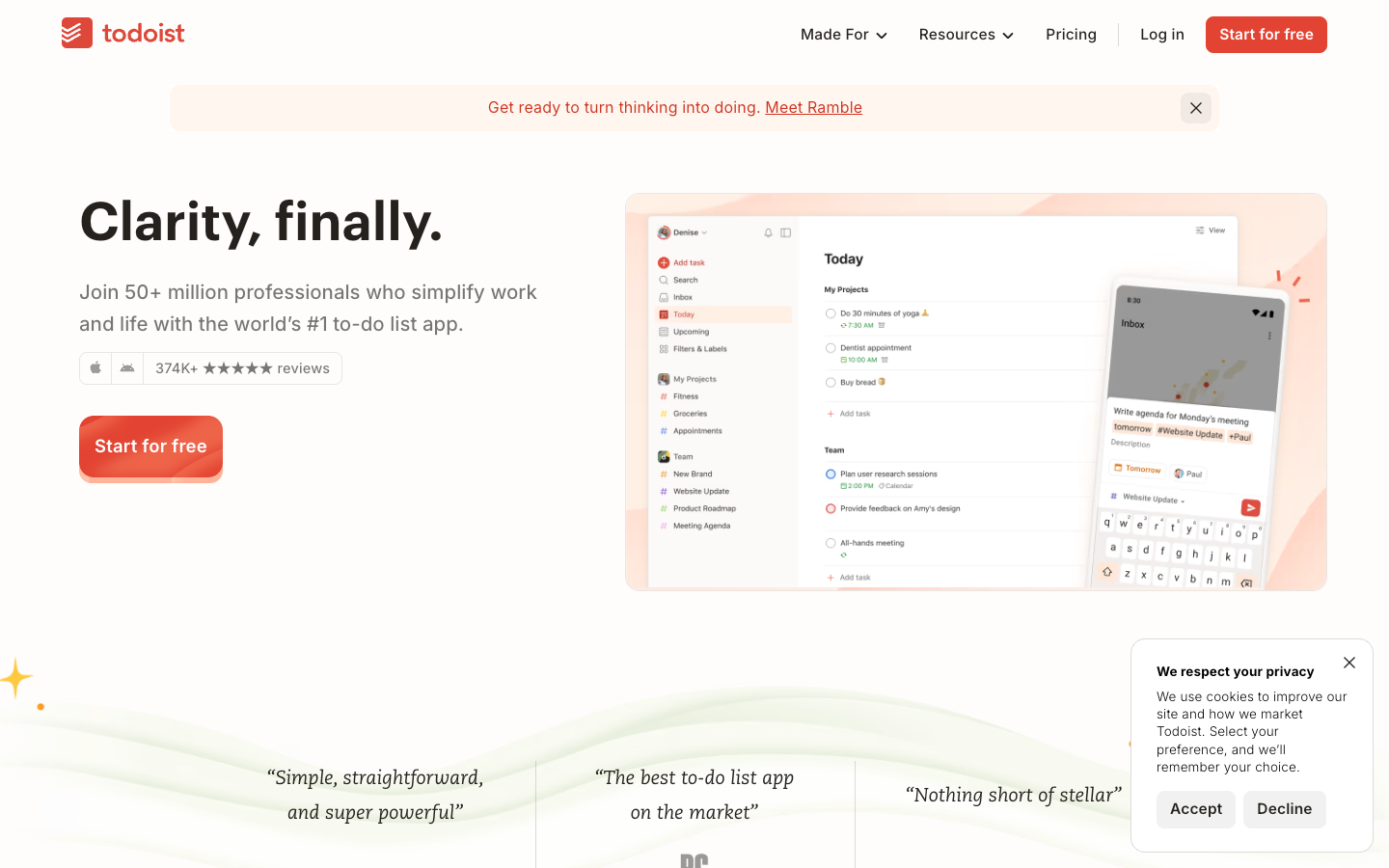
Todoist is a cross-platform task manager used by millions globally. It organises tasks with priorities, due dates, recurring reminders, projects, and labels — and syncs across every device.
At a glance:
- Best known for: Clean, powerful task management with cross-platform sync
- Main use case: Personal and professional task and project management
- Designed for: General adults — not built for ADHD specifically
- Pricing: Free tier. Pro ~$4/month or ~$48/year (prices increased late 2025).
- Platforms: iOS, Android, Web, Windows, Mac
Is Todoist Good for ADHD?
It depends entirely on what you need. Todoist is excellent at capturing, organising, and reminding. It doesn't help you start.
Where it actually helps
Frictionless task capture. The quick add feature — type a task, Todoist interprets the date and priority — is genuinely fast. For ADHD brains that need to externalise thoughts before they evaporate, a low-friction capture tool matters.
Reliable reminders. If you need the app to remind you something exists, Todoist's reminder system is solid. Cross-platform, reliable, customisable.
Subtask breakdowns. Breaking a large task into smaller steps is a legitimate ADHD strategy. Todoist's subtask feature supports this cleanly.
Where it falls short for ADHD
Looking at the list doesn't create motivation to start. This is the core ADHD problem with any task manager. The list is visible. The task is clearly defined. The due date is real. And you still can't make yourself begin. No task manager addresses this — because it's not a task management problem.
Overdue tasks create shame spirals. When things pile up as overdue, Todoist shows you the evidence. For ADHD adults already prone to shame about productivity, a growing backlog of red overdue tasks is actively discouraging.
No body doubling, no accountability, no community. Todoist is a solo tool. ADHD brains often need another person's presence to initiate tasks — something no task list can replicate.
Six Alternatives Worth Trying
1. Inflow — Addressing the Gap Between the List and Doing the List
.png)
Inflow doesn't replace Todoist — many ADHD adults use both. What it addresses is the layer Todoist can't touch: why starting is so reliably difficult, what emotional patterns are driving the avoidance, and what to actually do when you're sitting in front of a full list and still can't move.
The app is built specifically for ADHD, grounded in CBT, and covers the patterns that make task management hard to sustain: procrastination, shame cycles, task initiation difficulty, emotional dysregulation, and the very specific experience of knowing exactly what you need to do and still not doing it.
What's inside:
- Daily CBT-based modules on task initiation, procrastination, and executive dysfunction — the upstream causes of why lists don't become actions
- Virtual coworking rooms — body doubling with other ADHD adults. The social presence that gets tasks started when internal motivation isn't enough
- Quinn, the AI support tool — available when you're stuck in front of a task and can't begin. ADHD-specific guidance, not generic productivity tips.
- Community of ADHD adults sharing the same experience of having the list and not doing it
No streak mechanics. 7-day free trial. Refund available within 7 days of first payment if you subscribed through Inflow's website and haven't meaningfully used the app.
Pricing: From $0.33/day (billed annually).
Platforms: iOS, Android.
Try it: Take Inflow's ADHD quiz to get started.
2. TickTick — Task Manager with Pomodoro Built In
TickTick is a full-featured task manager with one meaningful advantage over Todoist for ADHD users: the Pomodoro timer is embedded directly in the task view. You see the task, press start on the timer, and you're working — without switching apps or making another decision.
Removing the switch between "task list" and "focus timer" removes one of the micro-friction points where ADHD brains get stuck.
Best for: ADHD adults who want task management and focus timing in one place — reducing the gap between deciding to work and actually starting.
Considerations: Pomodoro timer, habit tracker, and calendar view are Premium features. Overdue task display can still trigger shame responses.
Pricing: Free tier. Premium $35.99/year.
Platforms: iOS, Android, Web, Windows, Mac.
3. Tiimo — Visual Planning for ADHD Time Blindness

Tiimo is a visual daily planner designed specifically for neurodivergent users. Where Todoist shows you a list of tasks, Tiimo shows you tasks on a colour-coded timeline — making time visible and concrete rather than abstract.
For ADHD adults who lose track of the whole day rather than individual tasks, Tiimo addresses the time blindness that makes scheduling unreliable regardless of how well-organised the task list is.
Best for: ADHD adults who know what needs doing but consistently lose track of when things fit into the day.
Considerations: Initial setup requires sustained planning effort. More of a planning tool than a task capture tool.
Pricing: Free tier. Pro ~$7–$12/month depending on region.
Platforms: iOS, Android, Web, Apple Watch.
4. Structured — Visual Day Planner with Calendar Sync
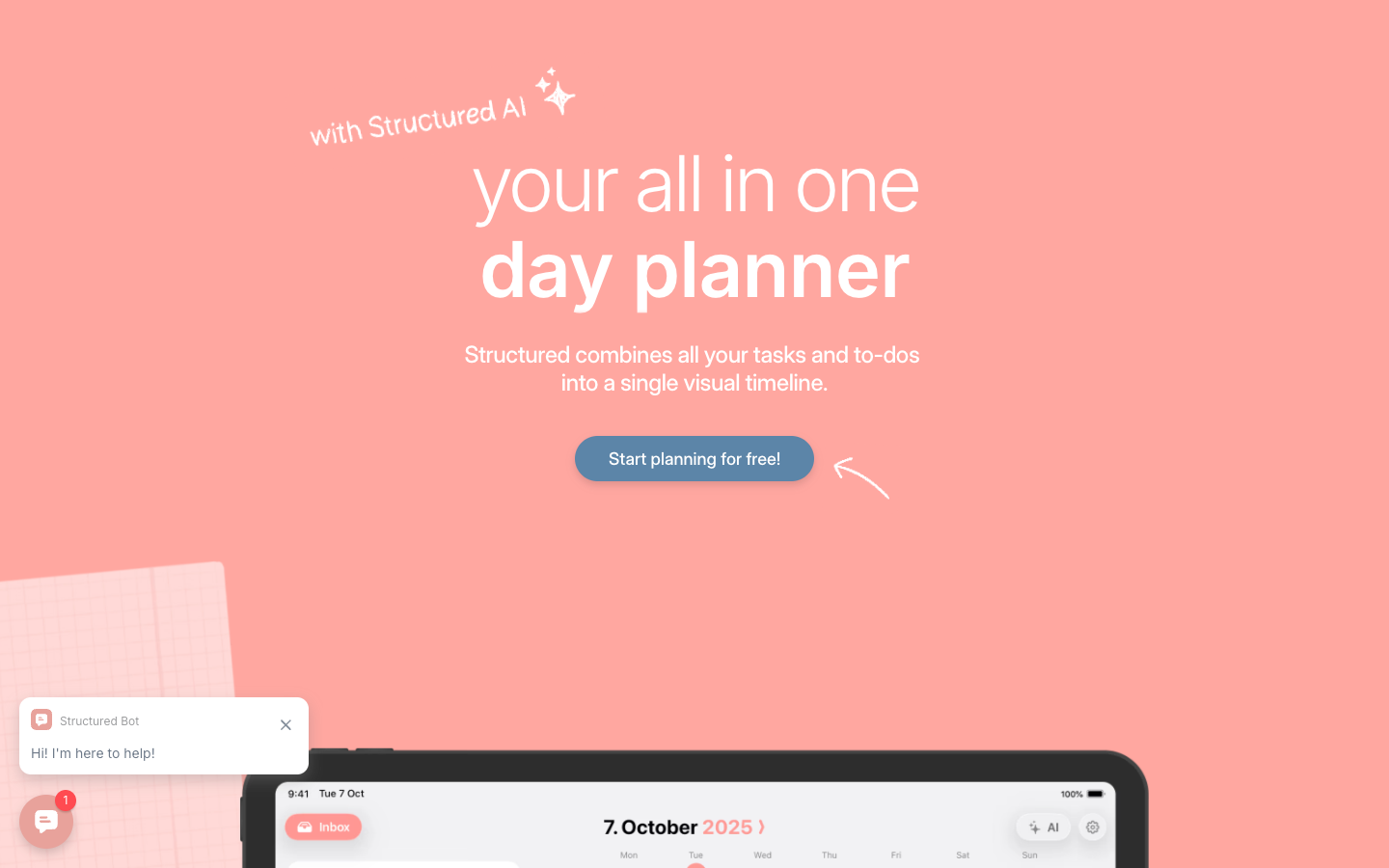
Structured is a visual day planner that maps tasks and calendar events onto a colour-coded timeline. Less neurodivergent-specific than Tiimo, but more affordable — and it syncs with existing calendars so existing commitments appear automatically.
For ADHD adults who need to see tasks in the context of the full day — not just as a disconnected list — the visual timeline format makes the day's reality visible before it collapses.
Best for: ADHD adults who need their task list and calendar events visible in one place — and tend to over-schedule without realising.
Pricing: Free tier. Pro ~$19.99/year.
Platforms: iOS, Android, Web.
5. Focusmate — Social Accountability for Task Initiation
Focusmate pairs you with another person over video for a defined work session. You state your task, work in silence, check in at the end. No coaching — just the presence and implicit accountability of another person watching you work.
For ADHD adults whose task initiation problem is neurological rather than organisational — the task is clear, the tool is ready, and they still can't start — Focusmate addresses the mechanism directly.
Best for: ADHD adults who can organise tasks fine but can't make themselves start without external presence or accountability.
Pricing: Free (3 sessions/week). $8/month billed annually for unlimited.
Platforms: Web only.
6. Finch — For When the Overdue List Has Become a Source of Shame
Finch is a self-care app with a virtual pet bird. No tasks, no priorities, no overdue items. Just small wellness goals with no performance standard.
If your Todoist inbox has become a source of dread rather than direction — a record of everything you haven't done — Finch provides a reset before you attempt any organised system again.
Best for: ADHD adults who need to detach from task management anxiety before returning to any structured productivity tool.
Pricing: Free core version. Finch Plus ~$69.99/year.
Platforms: iOS, Android.
Side-by-Side Comparison
How to Choose
You need a fast, reliable task capture tool. Todoist. The quick-add feature is still one of the fastest in the category.
You have the list but can't make yourself start. Inflow for understanding the patterns underneath. Focusmate for external accountability in the moment. Both address what Todoist can't. Take the quiz.
You want task management and a focus timer in one app. TickTick. Reduces the app-switching friction that ADHD brains get stuck on.
Time blindness is the bigger problem — not task organisation. Tiimo or Structured for visual timeline planning.
The task list has become a source of dread. Finch. Step away from task management entirely and reset.
Final Thoughts
Todoist is a well-made, reliable task manager. The problem is that ADHD isn't a task management problem. It's an initiation problem, an emotional regulation problem, a time blindness problem — and sometimes a shame problem made worse by the accumulation of overdue red labels.
If Todoist is working for capture and reminders, keep using it. But if you're finding that a perfect list doesn't translate to actual work, the tools above address different parts of why.
Start with understanding, not another system
Take Inflow's free ADHD quiz to see what's actually getting in the way — and how an ADHD-specific approach might change it. 7-day free trial, refund available within 7 days of your first payment through Inflow's website.
Frequently Asked Questions
Is Todoist good for ADHD?
Todoist is excellent for ADHD adults who need a reliable, fast way to capture and organise tasks. Where it falls short is task initiation — it can show you what to do clearly, but can't help you start doing it. For many ADHD adults, that gap is the actual problem.
What is the best task manager for ADHD?
Tiimo and TickTick are both designed with ADHD in mind — Tiimo for visual time-based planning, TickTick for task management with integrated focus timing. For ADHD adults who need to understand why task management systems keep failing, Inflow addresses the CBT and executive function layer that no task manager can reach.
Is Todoist or Inflow better for ADHD?
Different tools. Todoist manages tasks. Inflow addresses the ADHD patterns that make any task management system hard to sustain. Most ADHD adults benefit from both — a task manager for capture, and ADHD-specific support for initiation and emotional regulation.
Why does Todoist stop working for ADHD users?
Usually because the problem was never the list. ADHD task initiation difficulty is neurological — internal motivation doesn't activate reliably from a visible task list alone. The accumulation of overdue tasks also creates shame, which makes the app harder to open over time.
What are the best free task management apps for ADHD?
Todoist's free tier is functional for basic task capture. TickTick's free tier includes task management without the Pomodoro. Tiimo and Structured both have free tiers. Focusmate has a free tier with three body doubling sessions per week.


