


There's a reason Finch has such a loyal following in the ADHD community. It asks almost nothing from you. There's no streak to maintain, no performance standard to meet, no record of the days you didn't show up. Just a small bird that grows because you did something — anything — for yourself today.
For ADHD adults who've burned out on productivity apps that feel like they're keeping a running tab on your failures, Finch does something quietly radical: it doesn't judge you for being inconsistent.
But Finch is also deliberately limited. It nurtures the habit of daily self-awareness without building the skills or structures that make that self-awareness lead somewhere. This guide looks at what Finch does well, where it stops, and six alternatives that take different steps from where Finch leaves off.
What Is Finch?
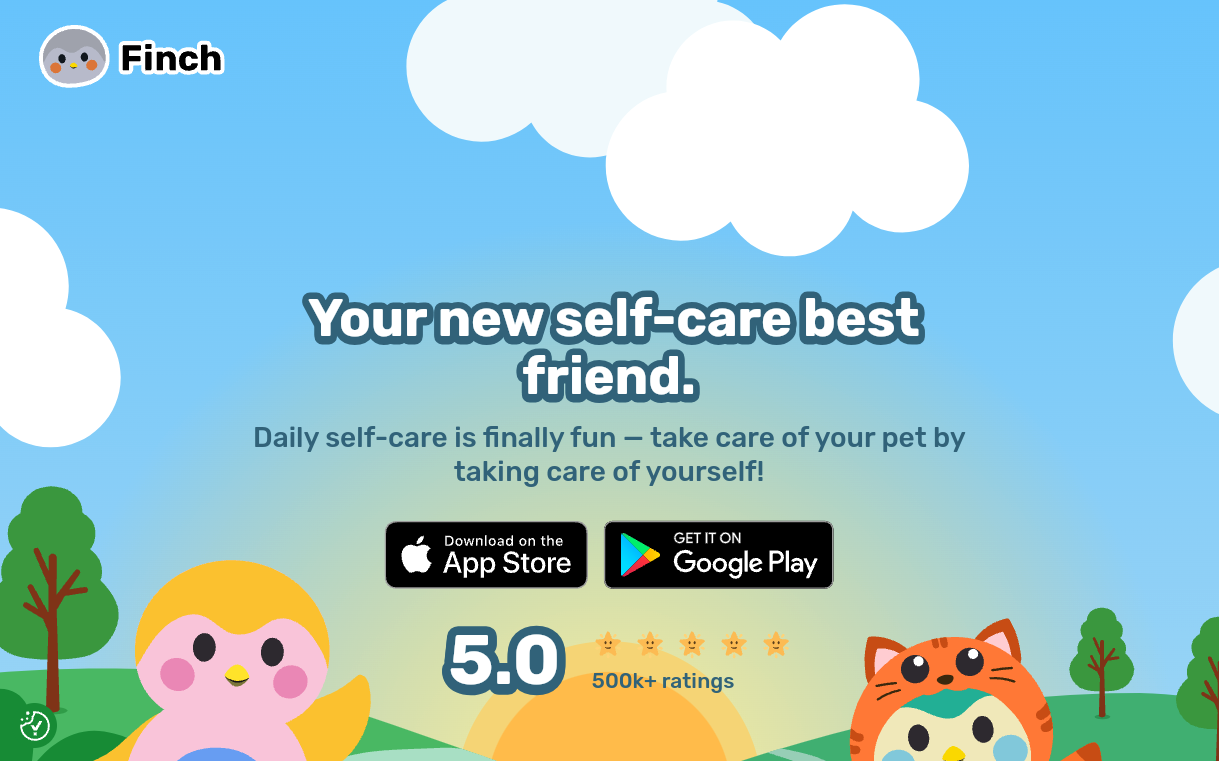
Finch is a self-care app built around the concept of nurturing a virtual pet bird. Complete small wellness goals — mood check-ins, self-compassion prompts, breathing exercises — to help your bird grow and travel the world.
At a glance:
- Best known for: No-pressure self-care through a gamified virtual pet mechanic
- Main use case: Daily mood check-ins, self-compassion, and low-barrier emotional wellness
- Designed for: General adults — widely used by ADHD and neurodivergent communities
- Pricing: Free core version. Finch Plus ~$69.99/year.
- Platforms: iOS, Android
Is Finch Good for ADHD?
Genuinely yes — for a specific purpose. Finch is excellent at what it's designed to do: provide a low-barrier daily self-care touchpoint with no punishment for inconsistency.
Where it actually helps
No streak mechanics — ever. Finch was built without punishing mechanics. You can disappear for two weeks and come back without any visual record of absence or a reset to mourn. For ADHD adults who've had the same streak-guilt-avoidance cycle with every other app, this changes the relationship with daily check-ins entirely.
Small goals feel achievable. The gamification isn't about performance — it's about accumulation. Small actions add up to a growing bird, a travelled map, a visual record of showing up. The reward mechanism is gentle enough not to backfire.
The emotional check-in habit has real value. Many ADHD adults aren't great at noticing their emotional state until it's already at a 9/10. Finch's daily prompts build a small but consistent emotional awareness practice.
Where it falls short for ADHD
Finch nurtures self-care without building skills. It helps you notice how you're feeling. It doesn't teach you what to do with that feeling — the CBT skills, the emotional regulation strategies, the executive function tools that turn self-awareness into actual change.
Very limited support for executive function challenges. Task initiation, time blindness, procrastination, shame cycles — none of these are addressed within Finch's framework. It's emotional wellness for the best days, not a tool for the hardest ones.
Six Alternatives Worth Trying
1. Inflow — The Next Step When Self-Awareness Isn't Enough
.png)
Finch helps you notice your emotional state. Inflow helps you understand why ADHD produces those emotional states — and gives you CBT-based tools to work with them rather than just acknowledge them.
If you've been using Finch for a while and want to go deeper — to actually understand the shame cycles, the rejection sensitivity, the emotional flooding that ADHD produces and build skills around them — Inflow is where that journey continues.
Critically, Inflow has no streak mechanics either. It was designed for the same inconsistent, nonlinear engagement that Finch accommodates — which means transitioning between the two doesn't require starting a new consistency battle.
What's inside:
- CBT modules on ADHD-specific emotional patterns — what Finch's check-ins reveal, and what to actually do about it
- Virtual coworking rooms and drop-in focus sessions — the accountability layer for the executive function challenges Finch doesn't touch
- Quinn, the AI support tool — available in real time when emotional regulation is needed, not just for a daily check-in
- Community of ADHD adults for the peer connection Finch's solo format doesn't provide
7-day free trial. Refund available within 7 days of first payment through Inflow's website.
Pricing: From $0.33/day (billed annually).
Platforms: iOS, Android.
Try it: Take Inflow's ADHD quiz to get started.
2. Wysa — CBT Exercises for What the Mood Check-In Surfaces
Wysa is a free AI-powered mental health chatbot grounded in CBT and DBT. Where Finch asks how you're feeling, Wysa helps you actively work through the thought patterns underneath — through short, conversational exercises rather than passive mood logging.
For ADHD adults who want the next step from emotional awareness into emotional processing — without a full therapy commitment — Wysa provides that at no cost.
Best for: ADHD adults who want CBT-based exercises to work through what Finch's check-ins surface — particularly negative self-talk, shame, and all-or-nothing thinking.
Pricing: Free core tier.
Platforms: iOS, Android, Web.
3. Fabulous — Gradual Habit Building When Ready for More Structure

Fabulous is a habit and routine-building app grounded in behavioural science. It builds routines incrementally — starting with one small action and layering from there.
If Finch has helped you rebuild a basic relationship with daily self-care and you're ready for more structure, Fabulous's gradual approach is a natural next step — more ambitious than Finch but more forgiving than most full routine apps.
Best for: ADHD adults who have stabilised with Finch and are ready to gradually build more structured daily habits.
Considerations: Streak mechanics present — which worked against many ADHD users in their previous experiences with habit apps. Billing issues reported in 2026 — review subscription terms carefully.
Pricing: ~$39.99/year. 7-day free trial.
Platforms: iOS, Android.
4. Tiimo — Visual Planning When Self-Care Needs a Time Container
Tiimo is a visual daily planner designed for neurodivergent users. For ADHD adults who want to build self-care into their day as a scheduled activity — visible on a timeline, given a specific time slot — rather than just a whenever-I-remember practice, Tiimo provides the visual structure.
Best for: ADHD adults who want to formalise their self-care as a time-blocked daily activity, making it as visible and predictable as any other scheduled commitment.
Pricing: Free tier. Pro ~$7–$12/month.
Platforms: iOS, Android, Web, Apple Watch.
5. Headspace — A Structured Daily Mindfulness Practice

Headspace is a structured meditation app with defined courses and short daily sessions. For ADHD adults who have built a basic self-care habit with Finch and want to add a mindfulness practice, Headspace's structured course format reduces the decision overhead of starting.
Best for: ADHD adults who want to add a daily mindfulness practice alongside their Finch self-care habit — and need structure and short sessions to make it stick.
Pricing: $12.99/month or $69.99/year.
Platforms: iOS, Android, Web.
6. Bearable — Detailed Tracking for When You Want to See Patterns

Bearable is a highly customisable health tracking app. You log mood, symptoms, sleep, medications, habits, and contextual factors — and the app surfaces correlation data over time, showing what actually affects your wellbeing.
For ADHD adults who've been mood-checking with Finch and want to understand what the patterns mean — not just that mood varies, but what drives the variation — Bearable provides the data layer.
Best for: ADHD adults who want to move from simple mood check-ins to understanding the correlations — sleep, exercise, medication, stress — that drive ADHD daily experience.
Pricing: Free tier. Premium ~$4.99/month.
Platforms: iOS, Android.
Side-by-Side Comparison
How to Choose
You need the gentlest possible daily self-care starting point. Finch. No other app on this list makes daily self-care this frictionless.
You're ready to go deeper than mood check-ins. Inflow for ADHD-specific CBT content and skills. Wysa for free CBT exercises. Both build on what Finch surfaces. Take the quiz.
You want to understand what drives your mood patterns. Bearable. Correlation tracking rather than simple mood logging.
You want to gradually add more structure. Fabulous — with awareness of the streak mechanics that have burned ADHD users before.
You want self-care as a visible scheduled activity. Tiimo for visual time-blocking.
You want a mindfulness practice to complement daily check-ins. Headspace for structured short sessions.
Final Thoughts
Finch is one of the most genuinely ADHD-friendly apps available — not because it's the most powerful, but because it's the most forgiving. In a category full of tools that punish inconsistency, Finch doesn't care if you missed yesterday.
That gentleness has real value. It's also a ceiling. Finch won't teach you to manage ADHD — it'll give you a safe place to check in on how you're doing while you figure out the rest.
The alternatives above represent different next steps from that foundation. The right one depends on what you're ready to add.
Find the tools that fit where you are
Take Inflow's free ADHD quiz to understand your current challenges and find what might help. 7-day free trial, refund available within 7 days of first payment through Inflow's website.
Frequently Asked Questions
Is Finch good for ADHD?
Yes — especially for ADHD adults who've burned out on streak-based apps. Finch's no-punishment design, small goals, and gentle gamification make daily self-care habits more sustainable for ADHD brains. Its limit is depth — it builds awareness without building skills.
What is the best self-care app for ADHD?
For gentle, no-pressure daily self-care: Finch. For ADHD-specific skill-building alongside self-care: Inflow. For free CBT-based emotional processing: Wysa. The right choice depends on what you're currently able and ready to engage with.
Is Finch or Inflow better for ADHD?
Different purposes and different stages. Finch is a gentle starting point — low commitment, no shame. Inflow is for building understanding and skills — CBT-based, ADHD-specific, with community and body doubling. For many ADHD adults, both serve a role at different times.
Why do ADHD adults love Finch?
Mainly because it doesn't punish inconsistency. ADHD engagement is naturally nonlinear — intense periods followed by gaps. Finch is designed without streak mechanics, which means returning after a difficult period doesn't come with a reset or guilt. That's relatively rare in the app category.
What are the best free self-care apps for ADHD?
Finch's core features are free. Wysa's core CBT chatbot is free. Both provide genuine value without requiring a subscription.


